
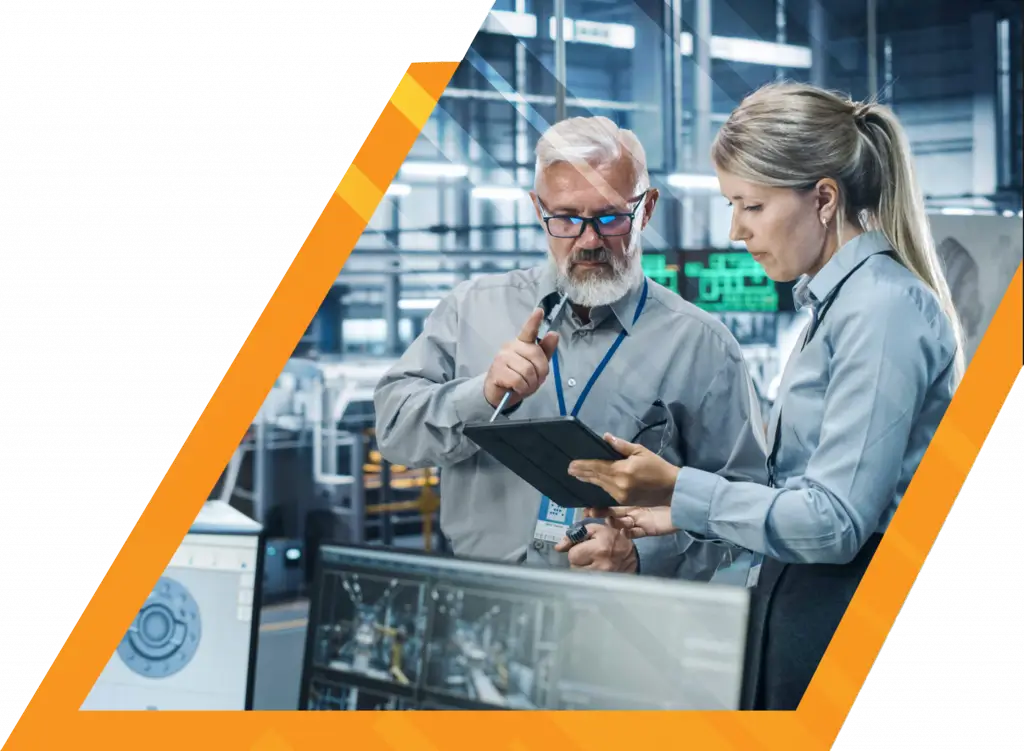

AI is here. But is the manufacturing world ready for it?
Manufacturing is undergoing one of the most signifcant periods of change in decades. Electrifcation, lightweighting, robotics, automation, and digitalization are reshaping how products are designed, built, and maintained. But the true challenge is not adopting new technology – it is ensuring people can keep pace with it.
Across various manufacturing industries, we see the same tension. Products are becoming more complex. Requirements are changing faster. Roles are expanding. Yet much of the knowledge people rely on remains difficult to access, hard to transfer, or disconnected from day-to-day work.
AI-powered learning and knowledge tools are emerging as powerful accelerators in this environment. At THORS, we have seen manufacturers use these tools not as standalone technologies, but as enablers of a more agile,
capable, and connected workforce. When applied thoughtfully, AI becomes a way to preserve expertise, support better decisions, and reduce friction across operations.
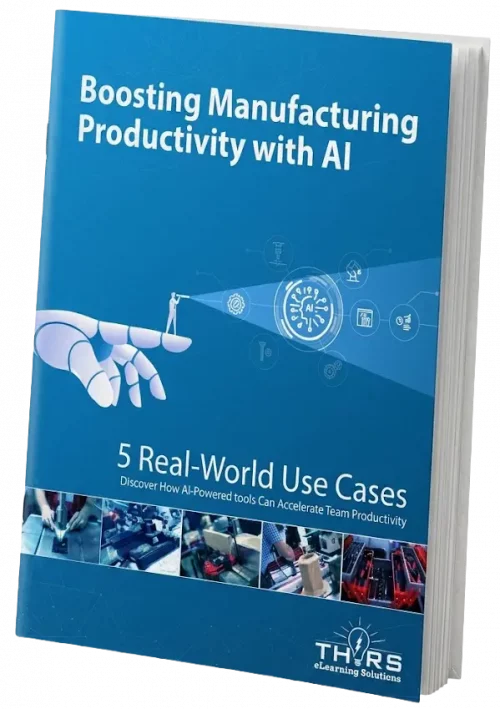
This guide presents five real-world use cases taken from manufacturers who are taking practical steps to move their teams toward greater knowledge, efficiency and collaboration. Those are the real benefits of AI.
5 Real-World AI Use Cases
-
Making Expertise Available to Everyone
Capturing tribal knowledge to ensure business continuity -
Ensuring the Right Information is Accessible 24/7
Working from the same standardized, vetted content, in one place -
Accessing Trusted Knowledge in Real Time
Ensuring access to knowledge in the ow of work for every employee -
Personalization: Making Learning Fit the Learner
Moving away from generic learning to personalized development -
Scaling Knowledge Across the Organization
Learning that scales across every team, level, and location
Lorem Ipsum

Making Expertise Available to Everyone
When a plating company changes hands – the new owner uses an AI-powered learning platform to extract deep expertise from the prior owner to ensure business continuity.
Many manufacturers rely, often quietly, on a few key people who “just know” how things work.
They know the right surface finish for a long time customer. They remember the special packaging note that appears once in a legacy specification. They understand the unwritten rule about how a particular part behaves in plating or heat treating. Over time, decisions, exceptions, and judgment calls accumulate – and eventually, all of it lives in someone’s head.
This can work for years – until it doesn’t.
When that key person retires, sells the company, or simply changes jobs, the knowledge gap is immediate and painful. Training a successor becomes a race against time, and even the most thoughtful handover can’t fully transfer decades of intuition and experience. What once felt like institutional memory suddenly reveals itself as a single point of failure. This is exactly the situation one small plating company found itself in during a generational transition.
This is exactly the situation one small plating company found itself in during a generational transition.
Capturing the knowledge already embedded in the business – and making it accessible through AI – doesn’t just protect what’s been built. It gives the next generation a stronger starting point, allowing them to move faster, act with confidence, and avoid costly blind spots.
Ownership transfer leaves a knowledge gap. The plating company was small – around a dozen employees – but their work was complex. They specialized in plating operations, serving multiple customers with highly specific quality and process requirements. The previous owner had run the business for two generations:
first in her family’s hands, then in her own. Over time, she became the connective tissue of the operation.
She knew everything by heart:
- Which customer required which plating specification
- The exact material and quality requirements each print implied
- Where the relevant documents were stored – and which version could be trusted
- How to interpret shorthand, tribal language, and legacy expectations that were never fully written down
When she decided to sell the business, the challenge quickly became clear. There was far more knowledge in her head than in the company’s systems.
Setting the stage for success. The new owner had worked in the business, but in a different role. Suddenly, he was responsible for understanding every customer’s plating requirements, ensuring the right specifications were followed for each job, answering questions from employees who used to “just ask the owner,” and keeping production moving while still learning how the business actually ran.

The Solution
To ensure a smooth ownership transition, the owners worked together to gather every document they could find that contained critical knowledge:
All of it was uploaded into an AI-powered environment using THORS’ MFG Genius.
For the new owner, this created something powerful: a digital proxy for the previous owner’s brain. Now, when he needed an answer, he could simply ask the AI assistant. The system returned the relevant specification text, the surrounding context from the original document, and links back to the source so he could validate and explore further.
- Customer plating requirement specications (SPG, MPS, and others – each with its own numbering and revisions)
- Equipment documentation and maintenance notes
- Process descriptions and work instructions
- Any written material that revealed how work was actually done in practice
All of it was uploaded into an AI-powered environment using THORS’ MFG Genius.
For the new owner, this created something powerful: a digital proxy for the previous owner’s brain. Now, when he needed an answer, he could simply ask the AI assistant. The system returned the relevant specification text, the surrounding context from the original document, and links back to the source so he could validate and explore further.
MFG Genius responds to technical specification questions instantly – using trusted information sources
Lorem Ipsum
Takeaways
1
Tribal knowledge is both a strength and a liability.
The people who “just know” how things work are invaluable – but relying on them alone creates a silent risk. When they leave, the organization absorbs the shock.
2
Knowledge transfer doesn’t have to be perfect to be powerful.
By centralizing and indexing critical business documents in an AI-powered knowledge platform, the business – as well as owners and employees – gain a practical, valuable source of truth.
3
Searchable beats memorable.
Expecting people to memorize key specications is unrealistic. Giving them a system they can query in natural language – with links to trusted sources – is far more eective and scalable.
4
Small companies feel the impact first – and strongest.
In small business, losing one person’s expertise can be crippling. AI-powered learning tools can act as a force multiplier, preserving specialized knowledge that may otherwise walk out the door.
5
This isn’t about replacing people; it’s about extending them.
During sta transitions, current employees can still train and support new ones. The AI environment doesn’t replace people – it extends their knowledge and passes it forward to others.
6
For decision makers, business continuity is key.
If your business depends heavily on a few key people, it’s time to shift from relying on one person’s memory to building shared intelligence – whether you realize it or not.
"We uploaded everything into our THORS AI-powered eLearning platform – all customer plating requirements, equipment documents, and process records. I’m using it as a kind of knowledge proxy because I don’t know all of that
information yet."
Ensuring the Right Information is Accessible 24/7
When critical knowledge lives in the heads of just a few experienced people, it creates risk. To solve this issue, a plating company turns to an AI-powered eLearning platform to capture their expertise, organize it, and make it available to everyone—anytime it’s needed.
Fill Out The Form to Download the full Paper


Latest from our Blog
How Statistics Is Used in Everyday Life
How Statistics Is Used in Everyday Life Statistics often remind us of data tables, charts, and calculations, but they are far more deeply woven into ...
Read More →
5 Common Electrical Measurement Errors and How to Avoid Them
In electrical systems, accurate electrical measurement is critical for maintaining performance, ensuring safety, and reducing ...
Read More →
Measurement System Analysis (MSA) Best Practices for Reliable Results
Measurement is the cornerstone of quality assurance in manufacturing. Measurement System Analysis (MSA) best practices ...
Read More →
Fine Blanking Presses: What Makes Them Unique?
What is fine blanking? Fine blanking is a metal forming process that uses fine blanking ...
Read More →
5 Key Reasons Why Bevel Gear Testing Matters
Bevel gear testing is essential because bevel gears are critical components used to transmit motion ...
Read More →
EMC in Automotive Wiring Harness Design: Key Principles and Best Practices
What Is EMC in Automotive Wiring Harness Design? Electromagnetic Compatibility (EMC) in automotive wiring harness ...
Read More →
Why Heat Treatment Matters for Industrial Aluminum Products
Aluminum is widely valued for being lightweight, corrosion-resistant, and easy to fabricate. However, in its ...
Read More →
Why Is PLC Ladder Diagram (LD) Widely Used in Industries?
PLC Ladder Diagram (LD) is one of the most widely used programming languages in PLC ...
Read More →
Power Converters Explained: AC to DC, DC to AC, AC to AC, and DC to DC
In electronics, power converters are devices that transform an input signal from one state or ...
Read More →
Save time on annual performance evaluations
Automate manual HR processes using your existing documents.
Generate customized assessments instantly with AI
Upload job descriptions, SOPs and work orders and let AI do the rest.
Upskill team members with targeted training
Deliver
personalized
learning that
targets individual
training needs.
Put the right people in the right roles
Hire qualified candidates based on relevant, data-driven insights
Candidate Assessments
Training
Needs ID
Process
Certification
Competency
Audits
Frequently Asked Questions About Competency Check 360 with AI
Get answers to common questions about how AI-powered competency assessments help you identify skill gaps, improve training, and make smarter workforce decisions.
What is Competency Check 360 with AI?
Competency Check 360 with AI is an AI-powered platform that evaluates employee skills against real job requirements. It helps you identify skill gaps, improve training effectiveness, and gain clear visibility into workforce readiness.
Want to see it in action?
How does AI help assess employee skills?
AI analyzes your job descriptions, SOPs, and work instructions to automatically generate role-specific competencies and assessment questions—ensuring evaluations reflect real work, not generic tests.
How does Competency Check 360 identify skill gaps?
The platform compares assessment results to role-specific competencies, highlighting exactly where employees excel and where they need improvement—at both individual and team levels.
How quickly can we create assessments?
Immediately. Simply upload your job descriptions or SOPs, and AI generates customized assessments in minutes—no manual setup required.
How does this improve training programs?
Instead of broad, one-size-fits-all training, you can deliver targeted learning based on actual skill gaps—saving time and increasing effectiveness.
What business problems does this solve?
- Lack of visibility into employee skills
- Time-consuming manual assessment creation
- Ineffective training programs
- Uncertain hiring or certification decisions
What results can we expect?
- Faster workforce upskilling
- Reduced training waste
- Improved productivity and performance
- More confident workforce decisions
Can this support hiring and certification decisions?
Yes. It provides objective, data-driven insights into competency levels, helping you make better hiring, promotion, and certification decisions.
Does it include pre-built assessments?
Yes. You get access to 230+ ready-to-deploy technical assessments across key business functions—so you can get started even faster.
What industries is this best suited for?
Any industry with defined roles and processes—including manufacturing, energy, logistics, and healthcare—can benefit from AI-driven competency assessments.
How do we get started?
Getting started is simple: upload your job documentation and let AI do the rest.