Thread rolling versus thread cutting is a decision often made early and by habit, and it quietly shapes how a threaded part behaves for the rest of its working life. One process removes metal to make threads. The other pushes metal into shape. That difference changes how strong the part is, how much material you buy, and how fast the line runs.
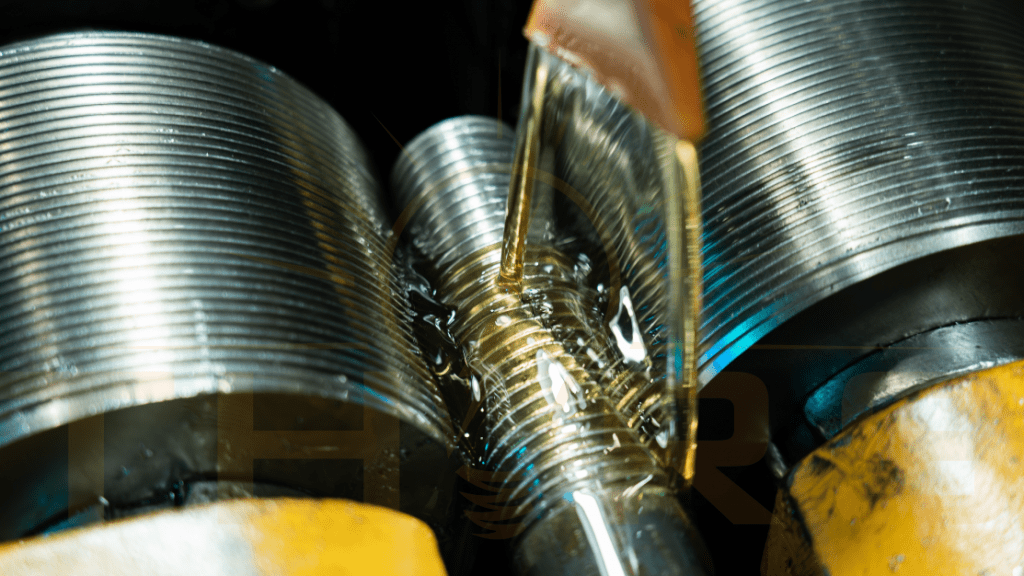
Thread cutting removes material. A tool cuts into a rotating blank and carves the thread groove out, producing chips. Thread rolling forms the material instead. The blank is pressed between hardened dies that push the metal outward into the shape of the thread, and nothing is cut away. Both processes produce external threads on cylindrical parts, which is how most threaded fasteners, pipes, and rods get their threads. Both make a thread that fits the same nut. They do not make the part with the same characteristics.
Thread Rolling
Thread rolling forms a thread by displacing metal rather than cutting it away, so the internal structure of the metal is never severed. Grain flow is the pattern that the structure takes as the metal is worked. In a rolled thread, the grain flow bends and follows the contour of the thread. In a cut thread, the grain flow is sliced across at every groove. Rolling is a kind of cold forming, meaning the metal is shaped below the temperature at which it would recrystallize.
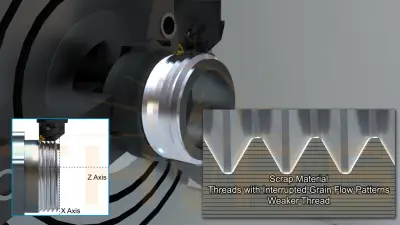
That structural difference is where the numbers come from. The Precision Machined Products Association, a United States trade body for precision machining companies, reports rolled threads as up to 30 percent stronger than cut threads. CJWinter, a manufacturer of thread rolling equipment, puts the improvement in fatigue strength at 50 to 75 percent. Fatigue strength is a part’s resistance to failing after repeated loading, which is how most threaded fasteners actually fail in service.
Speed and material are the commercial arguments. CJWinter reports that rolling runs at surface speeds up to ten times faster than single-point thread cutting, and completes a thread in one pass, whereas cutting averages ten passes. The starting blank is smaller than the stock a cutting operation needs, because rolling pushes metal outward to form the thread rather than cutting inward from the full diameter. Almost nothing becomes scrap.
Surface finish follows the same pattern. Rolled threads typically come in at 32 microinches Ra or better, while cut threads are rarely better than 63 microinches. Ra is a standard measure of surface roughness, and a lower number means a smoother surface. Smoother thread roots have fewer places to crack.
Best suited to: external threads on ductile metals in production volumes, such as bolts, studs, threaded rod, and pipe fittings.
The Discipline Behind a Good Rolled Thread
Those advantages are what rolling delivers when it is set up properly. Getting there requires more control than a cutting operation does. The starting blank has to be accurate before it reaches the dies, because rolling cannot correct the diameter it was handed. Thread diameter is one of several accuracy factors a rolling operation has to hold at once.
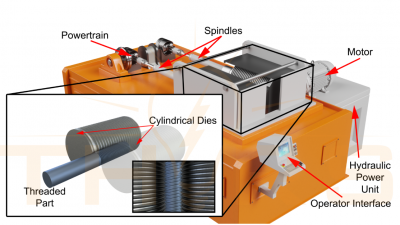
The machine has to suit the part. Several different machine and die configurations are used across the industry, and each one favors a different combination of part size, thread length, and production volume. For example, a two-cylindrical die machine can handle long thread lengths and high part diameters when compared to other types of thread rolling machines.
And when material flows into the die unevenly, it leaves characteristic surface defects. Each one has a recognizable appearance and a traceable cause. A shop that can read them corrects the process instead of scrapping the parts.
Thread Cutting
Thread cutting is the older and more flexible process, and it still handles the work that rolling cannot reach.
Internal threads come first. Rolling cannot form internal threads on a cylindrical part. A thread on the inside of a hole is made by tapping or by single-point cutting, so any part with a threaded hole needs a cutting operation no matter how its external threads are produced.
Material hardness comes second. Rolling needs metal that will flow. CJWinter notes that material for rolling needs some ductility and generally cannot be rolled once hardened. Ductility is a metal’s ability to deform without cracking. A part that is already hardened, or a material chosen for hardness rather than formability, has to be cut.
Volume comes third. Rolling dies are made for a specific thread, so the tooling is paid for before the first part exists. On a short run, a prototype, or a repair, a cutting tool already sitting in the shop that can perform thread cutting wins on cost every time.
Best suited to: internal threads, hardened or brittle materials, very large diameters, short runs, and repair work.
Conclusion
The thread rolling versus thread cutting question usually answers itself once you ask three things. Is the thread external or internal? Internal means cutting. Is the material ductile enough to flow, or is it already hardened? Hardened means cutting. How many parts are you making? Volume pays for rolling dies and then keeps on paying.
For the large middle ground of external threads on ductile metal in production quantities, rolling wins on strength, on speed, on surface finish, and on material cost. That is why most of the fasteners handled today were rolled rather than cut.
Thread rolling rewards a working understanding of the equipment, the process steps, and the defects that appear when something drifts. THORS introduces its new Thread Rolling Fundamentals course. Whether you are new to threaded parts or want to sharpen knowledge you already have, enroll today and build a foundation you can use on the floor.