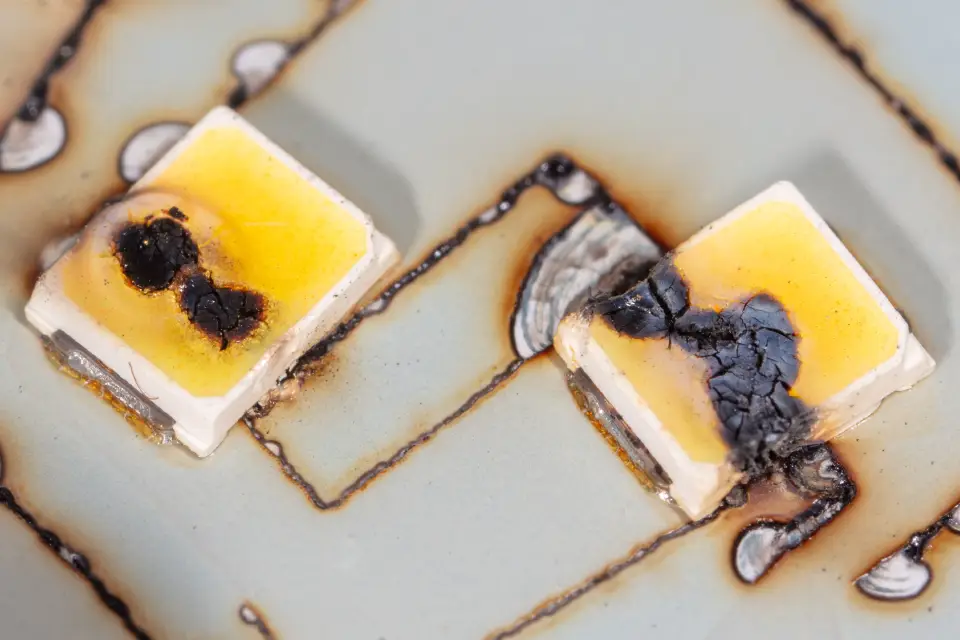
LED failure modes are the reason Light Emitting Diodes (LEDs) do not always live up to their reputation. Manufacturers often market LEDs as highly reliable light sources, with lifespans of up to 100,000 hours of continuous operation. On top of this, they are eco-friendly without emitting harmful gases and are 10 to 50 times more efficient than incandescent lamps. But if you have used LEDs, one of the most common questions is, “If LEDs last so long, why do they still fail?”
If you have ever seen an LED slowly lose its brightness, shift color, or fail much earlier than expected, it’s often traced back to hidden failure mechanisms within the LED chip, the package, or the lighting system itself. In this blog, we will take a closer look at where these failure mechanisms originate and the LED failure modes they cause.
Failure Mechanisms in the LED Chip
The LED chip, which is the core component of a packaged LED light source, is subject to the following failure mechanisms:
- Chip Cracking: Chip cracking is a physical fracture or split that can occur in the substrate or support layers caused by lattice mismatch or thermal stress.
- Defects: Defects in an LED chip are imperfections or irregularities in the semiconductor material or support layers. The increase in defects in a material causes failure mechanisms, such as nonradiative electron and hole recombination, thermal degradation, and the formation of leakage current paths.
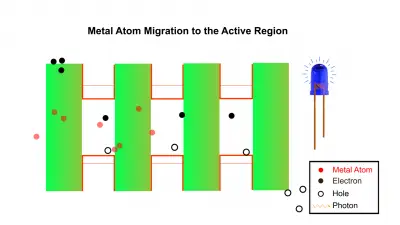
- Metal Atom Migration: Metal atom migration is a phenomenon in which metal atoms from the metal contacts or interconnects move into the semiconductor materials of the active region.
- Electrostatic Breakdown: An electrostatic breakdown is a phenomenon that occurs when a high voltage from static charge exceeds the dielectric strength of a material. This causes a sudden and large current flow that can damage the Multiple Quantum Well (MQW) structure and support layers.
- Interface Issues: Interface issues are problems that occur at the boundaries between different materials, such as semiconductors, metals, and insulators.
Failure Mechanisms in Package
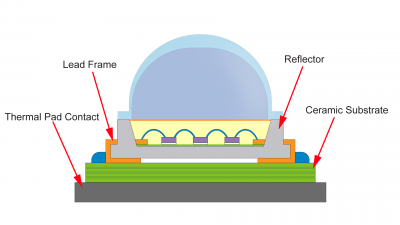
The package, which is the structural unit that houses the LED chip, is subject to the following failure mechanisms:
- Phosphor Deterioration: Phosphor deterioration is the degradation of the phosphor coating in LEDs that use encapsulants coated with phosphor. Over time, phosphor deterioration can occur due to carbonization or phosphor thermal quenching.
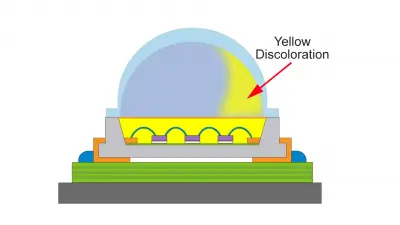
- Encapsulant Yellowing: Encapsulant yellowing is the yellow discoloration of the encapsulant material after a period of use. Prolonged exposure to high-intensity light can cause the encapsulant material to deteriorate and turn yellow over time.
- Delamination: Delamination is the partial or complete peeling of layers in a packaged LED due to thermal mismatch between the package material properties. Factors such as moisture, contamination, and thermal stress can also lead to delamination.
- Solder Joint Fatigue: Solder joint fatigue is the weakening of the solder material that electrically connects the LED chip to the Printed Circuit Board (PCB). Thermal cycling and mechanical stress over time can cause these joints to crack.
- Bonding Wire Failure: Bonding wire failure is the damage or breakage of the thin wire that connects the LED chip to the LED package. Vibrations, thermal cycling, and poor wire bonding techniques are often the causes of bonding wire failure.
- Wire Ball Bond Failure: Wire ball bond failure is the damage to the small, round connection where the bonding wire is attached to the contact pad on the LED chip. Factors such as moisture ingress, mismatch in material properties, and thermal cycling can damage the wire ball bond.
Failure Mechanisms in Lighting System
The lighting system, which is the overall assembly of a packaged LED light source, is subject to the following failure mechanisms:
- Material Degradation of the Ceramic Substrate: Material degradation of the ceramic substrate is caused by exposure to moisture or harmful chemicals, and the presence of contaminants on the ceramic substrate on which an LED chip is mounted.
- Delamination of the Thermal Pad Contact: Delamination of the thermal pad contact that acts as the interface material between an LED chip and a heat sink occurs due to thermal cycling or poor adhesion.
- Oxidation and Corrosion of the Lead Frame: Oxidation and corrosion of the lead frame that provides electrical connectivity between the LED chip and the external circuit are caused by exposure to moisture, high temperatures, and contaminants.
- Peeling of the Reflective Coating: Peeling of the reflective coating is caused by poor adhesion between the reflective coating and the reflector base.
- Overheating: Overheating is caused by inadequate thermal design, such as the use of inadequate heat sinks or materials with poor thermal interfaces.
- Voltage Fluctuations: Voltage fluctuations are caused by lightning, switching loads, or an unstable grid.
Common LED Failure Modes
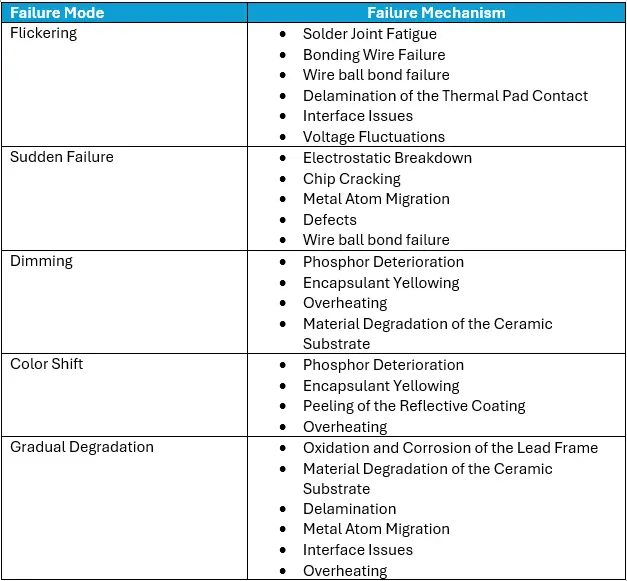
The failure mechanisms listed above lead to common failure modes such as flickering, sudden failure, dimming, color shift, and gradual degradation.
Are you interested in learning more about the failure mechanisms in LEDs and their resulting failure modes? The THORS Light Emitting Diode (LED) Failure Modes course provides a broad overview of common LED failure mechanisms and explains how they translate into real-world failure modes. Ready to uncover what really happens inside an LED when it fails?