Powder coating vs liquid painting is one of the first decisions a manufacturer makes about a metal part, and it settles far more than color. It affects cycle time, material waste, environmental permits, and how the part looks after ten years in service. Choosing wrongly is expensive to undo, because the two processes need different equipment, different floor space, and different skills.
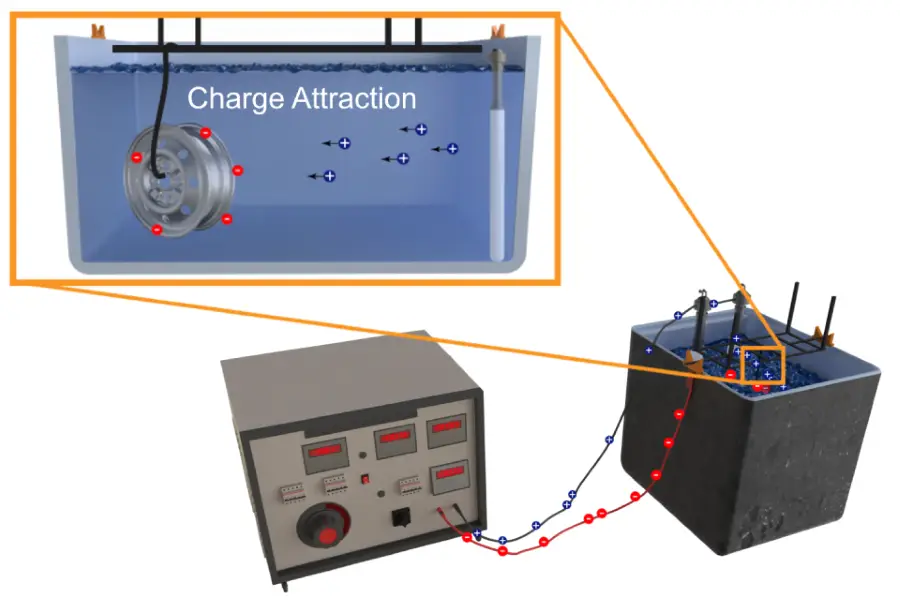
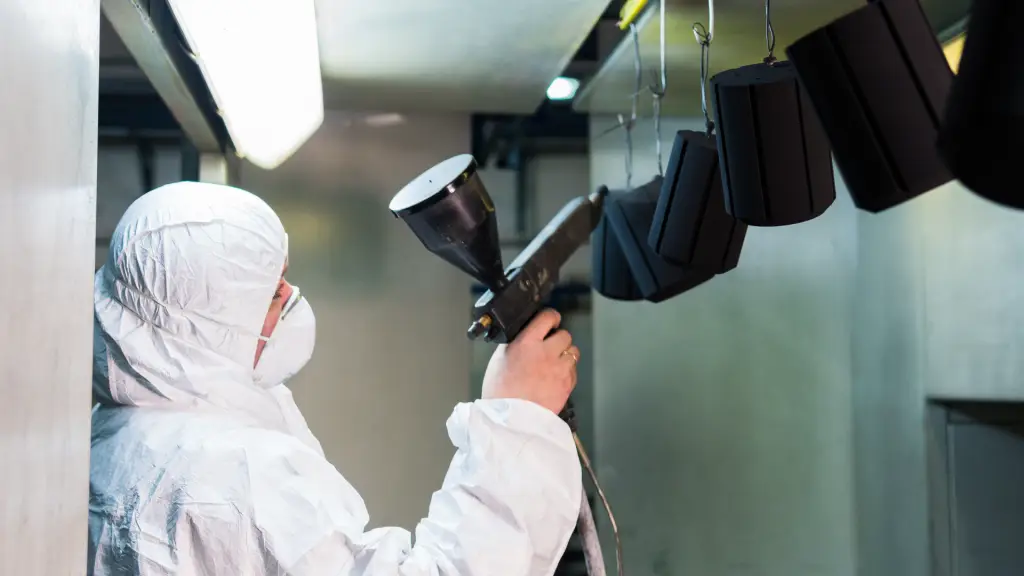
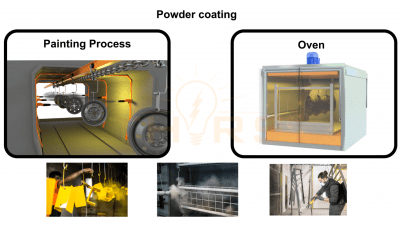
The two work in opposite ways. Powder coating sprays dry paint powder onto an electrically grounded part, then bakes the part so the powder melts and flows into a solid film. Liquid painting sprays paint that is already mixed with a solvent or with water, and the film forms as that carrier evaporates. One of the advanced liquid painting processes for metals, known as Cathodic Electrodeposition (CED) painting, dips the part into a paint bath and uses an electric current to pull the paint onto the metal.
Each one wins in a different situation. Here is what separates them.
Powder Coating
Powder coating uses no solvent at all. The powder is 100 percent solids, meaning everything sprayed can end up on the part, so one pass usually builds the film thickness that a liquid finish needs two or three coats to reach. Powder that misses the part is not lost either. It falls inside the booth and can be collected and sprayed again. Products Finishing, a United States finishing industry publication, reports transfer efficiency of 70 to 90 percent for powder against 25 to 65 percent for liquid paint, and overall system efficiency above 95 percent once you count reclaimed powder. Transfer efficiency is the share of sprayed material that actually lands on the part.
Because there is no solvent, powder releases no Volatile Organic Compounds (VOCs), which are the gases that evaporate from liquid paint, and most countries regulate them. Powder overspray is usually classed as nonhazardous waste. Liquid overspray often is not.
The trade-offs are heat and conductivity. The part has to conduct electricity to hold the charged powder, and it has to survive an oven. It also has to be genuinely clean when it reaches the booth, because powder will not cover up contamination the way a thicker liquid film sometimes can. Getting that preparation right is a discipline of its own.
The powder coating process is best suited for metal parts in medium to high volume that need a hard-wearing finish, such as appliance panels, electrical enclosures, wheels and outdoor furniture.
Liquid Painting
Liquid painting is an older and far more flexible process. The paint is wet when it reaches the part and dries at or near room temperature, so it will coat almost anything. Plastics, wood, glass, and assemblies that are too large or too heat sensitive for an oven are all within reach.
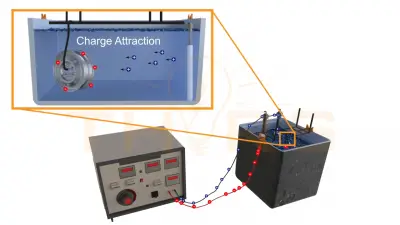
However, narrowing down to painting metals with liquid paint, CED painting is the way to go. The shop lowers the whole part into a tank of water-based paint and passes an electric current through the bath. The charged paint particles travel to the metal and build an even film on every surface the liquid reaches. THORS covers the tanks, the pretreatment stages, and the recovery systems in the CED Painting Basics course.
That difference matters for shape. A spray gun coats only what it can see, so box sections, seams, and internal corners are hard to reach. Immersion reaches them. This is why vehicle makers use CED on chassis and underbody parts, where corrosion protection has to get inside the structure rather than sit on the outside of it.
CED is not a general-purpose finish. The color range is narrow and usually matte, the equipment investment is high, and a damaged part normally goes back through the whole bath instead of a simple touch-up. Many plants therefore run CED first for corrosion protection and powder on top for color and durability.
Liquid painting also still has an edge in some appearance work. Solvent lets pigment flakes settle and line up as the film dries, which is how deep metallic and high gloss automotive finishes are built. Powder has closed much of that gap. TIGER Coatings, an Austrian coatings manufacturer, reports that its metallic powders now reach depth comparable to liquid paint, and powder adds textured finishes that liquid cannot produce.
The costs are waste and time. Liquid paint carries anywhere from under 30 percent to over 60 percent solids, so a large share of what is sprayed simply evaporates. Overspray cannot be recovered, and every color change flushes usable paint to waste. Parts also need drying time before anyone can handle them.
The CED painting process is suitable for very large assemblies with low volume, and for parts with intricate grooves and sharp corners.
Conclusion
Four questions usually settle the powder coating vs liquid painting decision:
- Can the part take oven heat, and does it conduct electricity? Powder coating needs both.
- How complex is the shape, and does paint have to reach inside it? That points to CED painting.
- How many parts need to be painted, and how often does the color change? Volume favors powder, while frequent short runs favor liquid.
- And how much does an exact color or a deep metallic effect matter? That’s the one area where liquid still holds an edge, though a narrowing one.
Most plants end up running more than one of these processes. Choosing well for each part is what keeps rework, warranty claims, and environmental costs down.
Powder coating is the process most manufacturers reach for first, and it rewards a real understanding of the powder, the equipment, and the coating process behind it. THORS introduces its new Powder Coating Fundamentals. Whether you are new to finishing or want to strengthen a foundation you already have, enroll today and work through powder coating from the powder itself to the cured film.