Did you know that the wrong soldering method can compromise an entire circuit board, even when components are placed correctly? Soldering is a critical process in transforming a Printed Circuit Board (PCB) into a Printed Circuit Board Assembly (PCBA) by forming joints to electrically and mechanically connect the mounted electronic components and the PCB. While the majority of PCBAs contain Surface Mounted Devices (SMDs), PCBAs that have a combination of SMDs and Through-Hole Devices (THDs) are not uncommon. Based on the design requirements, manufacturers use one or more PCBA soldering methods.
Reflow Soldering
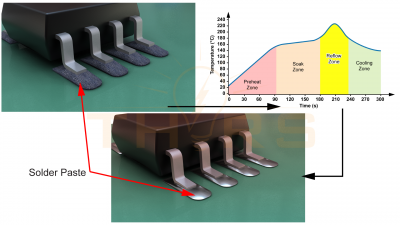
Reflow soldering is the primary method of rigidly joining SMDs to a PCB by heating the applied solder paste, allowing it to melt, then solidifying as it cools to form solder joints. A reflow oven is used in this process. The reflow oven is constructed with multiple temperature zones, each designed with a specific temperature gradient. The temperature is lowest in the preheat zone, stabilizes in the soak zone, peaks in the reflow zone, and then rapidly decreases in the cooling zone.
Application– This method is used for automated production and is suitable for medium to high volume manufacturing, particularly for compact boards.
The process of solidifying solder paste through the reflow soldering method.
Wave Soldering
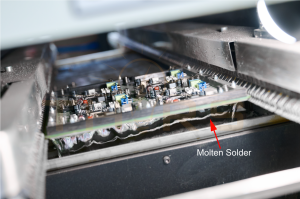
Unlike reflow soldering, wave soldering is primarily used to join THDs to a PCB. In this method, the operator first applies flux to the underside of the PCB, then passes the board over a tank of molten solder. Flux cleans metal surfaces and helps molten solder flow and bond properly during soldering. The molten solder forms a wave that washes over the underside of the PCB, soldering the exposed component leads. Some SMDs can be soldered using wave soldering.
Application– This method is used for mass soldering of boards with many THDs.
A PCBA immersed in molten solder in the wave soldering method.
Selective Soldering
For assemblies containing both SMDs and THDs, manufacturers often use selective soldering. This method enables THDs to be soldered by selectively exposing only the areas of the PCB with THD leads to flux and molten solder using a customized nozzle. The nozzle individually solders each THD location on the PCB. The user programs the selective soldering equipment. The program varies depending on the product being soldered, as does the nozzle.
Application– This method is used for mixed technology and dense boards.
Hand Soldering
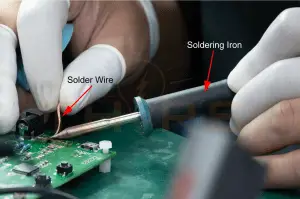
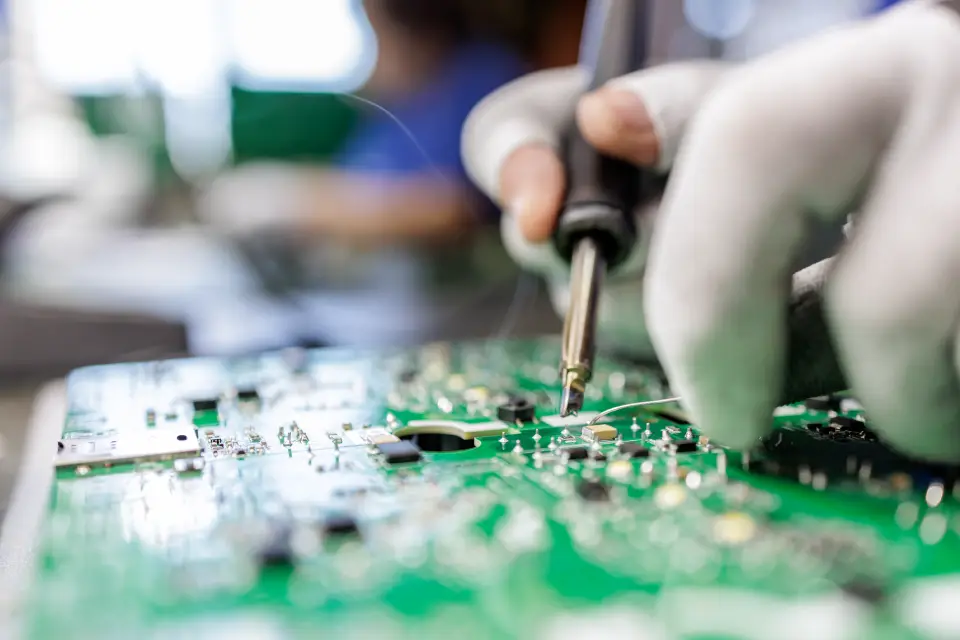
Hand soldering is a manual PCBA soldering method used for both THDs and some SMDs. This method uses a soldering iron to heat PCB pads and electronic component leads. Then, a solder wire containing flux in its core is fed into the heated pad and lead. The heat melts the solder wire, releasing molten solder that wets the pad and lead to form a solder joint. This method requires a high amount of human skill and training.
Application– This method is suitable for prototyping, quick repairs, and mounting very fine pitch electronic components.
The hand soldering method, where a solder iron is used to melt the solder wire to release molten solder for forming solder joints.
Laser Soldering
In contrast to contact-based techniques, laser soldering is an automated, noncontact method used for both THDs and SMDs. This method uses a laser beam to heat PCB pads and electronic component leads, forming solder joints. The heat melts the solder placed at the joints to form solder joints.
Application– This method is used in low volume production, complex assemblies, and high precision assembly involving miniaturized components.
Robotic Soldering
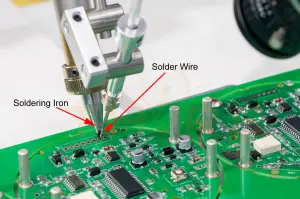
Building on hand soldering techniques, robotic soldering is an automated version of hand soldering in which programmable robotic arms hold and control the soldering iron and solder wire. By automating the soldering motion and process parameters, robotic soldering provides consistent joint quality.
Application– This method is suitable for medium to high volume production, particularly when the spacing between electronic components and leads is critically small.
The robotic soldering method, where robotic arms hold soldering iron and solder wire.
Conclusion
Understanding the different PCBA soldering methods used in PCBA is essential for anyone working with modern electronics. To build your understanding of soldering and the other processes involved in creating a complete PCBA, THORS introduces its new Printed Circuit Board Assembly (PCBA) Basics course. Whether you are new to electronics manufacturing or looking to strengthen your foundation, enroll today and confidently navigate the world of PCBA.
Gears are thought to be one of the oldest components known to humankind. Early examples of gears trace back to the fourth century BC in China. Since then,…
Whether it’s a whole machine, a simple component, or a complete vehicle, fasteners are essential to the construction of these objects. The absence of fasteners in…
Gear types can be classified according to the relative position of their axes of revolution. For example, there are gears for parallel shafts, gears for intersecting…