

Aluminum Casting Design Essentials

The THORS Aluminum Casting Design Essentials course is designed to provide learners with a foundational understanding of the essential considerations involved in aluminum casting design. It covers key design considerations that influence cast part design, the criteria used for material selection, and the common aluminum casting alloys. Ready to take the next step? Explore the course details and see everything we’ve packed into this program!

Learning Hours: 2

Representative or member of a corporation, educational institution, or trade organization? Contact us to discuss special pricing and additional benefits, including course activity reports for your group.

Contact Sales For Group Pricing

Course Description

The THORS Aluminum Casting Design Essentials course introduces the key considerations involved in aluminum casting design, focusing on early decisions that shape cast part development. This course covers design requirements, cost, annual usage volume, and other design considerations, including Design for Manufacturability (DFM), Design for Serviceability (DFS), and process ideation. It also explains the material selection criteria and the common aluminum casting alloys used in casting applications. Presented in a visually engaging and interactive format, this course provides a clear understanding of what it takes to design reliable aluminum cast parts.

YouTube player

Who will benefit from this aluminum casting design course?

Design engineers, manufacturing engineers, product engineers, casting engineers, materials engineers, and technical professionals involved in the design and development of aluminum cast parts.

Course Classification

This manufacturing course by THORS eLearning Solutions covers identification of key terms, understanding of key concepts, and application of the covered topics.

*THORS uses the Bloom’s Taxonomy Methodology for our course development.

Certificate Awarded for Aluminum Casting Design Essentials

Example of certificate awarded upon successful completion of the course.

*upon successful completion

Related Posts

Reference chart developed from fully mulled sand mixed with new sand, clay, and water used for estimating clay levels and compactability.
Castings

Green Sand Clay Level 101

In a previous post, we looked at ways to control sand compactability and how it is affected by process variables. The next important control variable is
Read More »

Learning Objectives

  1. Identify the key design considerations involved in aluminum casting design.
  2. Describe design requirements, cost, annual usage volume, and other key design considerations in aluminum casting design.
  3. Explain the importance of Design for Manufacturability (DFM), Design for Serviceability (DFS), and process ideation in aluminum casting design.
  4. Recognize the material selection criteria used to select aluminum casting alloys.
  5. Differentiate between common aluminum casting alloys.
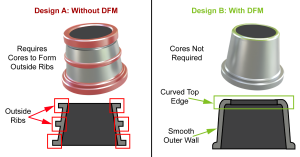
Comparison of two aluminum casting designs showing how Design for Manufacturability (DFM) simplifies tooling requirements.
Aluminum Casting Design Essentials Course

Table of Contents

  1. Design Considerations
    1. Design Requirements
    2. Cost
    3. Annual Usage Volume
    4. Dimensional Footprint
    5. Safety Factor
    6. Corrosion Resistance
    7. Load Changes
    8. Design for Manufacturability (DFM)
    9. Design for Serviceability (DFS)
    10. Process Ideation
  2. Casting Materials
    1. Material Selection Criteria
      1. Material Properties
        1. Tensile Strength
        2. Yield Strength
        3. Elongation
        4. Elastic Modulus
        5. Hardness
        6. High Temperature Strength
        7. Fracture Toughness
        8. Fatigue Performance
      2. Casting Characteristics
    2. Common Aluminum Casting Alloys
      1. 100 Series
      2. 200 Series
      3. 300 Series
      4. 400 Series
      5. 500 Series
      6. 700 Series
      7. 800 Series

Request Course Demo