Most manufacturers rely on tenure, job titles, and training records to gauge what their employees know. While these offer a general sense of experience, they don’t show whether each person truly understands every process they touch. Without a clear understanding of what employees know and where they need support, manufacturers are left guessing where to focus training, and the gaps they miss often surface as scrap, rework, quality escapes, or customer chargebacks.
A THORS baseline assessment gives manufacturers the visibility they’re missing, providing a clearer understanding of their workforce’s knowledge and capabilities.
Results from a real-world baseline assessment
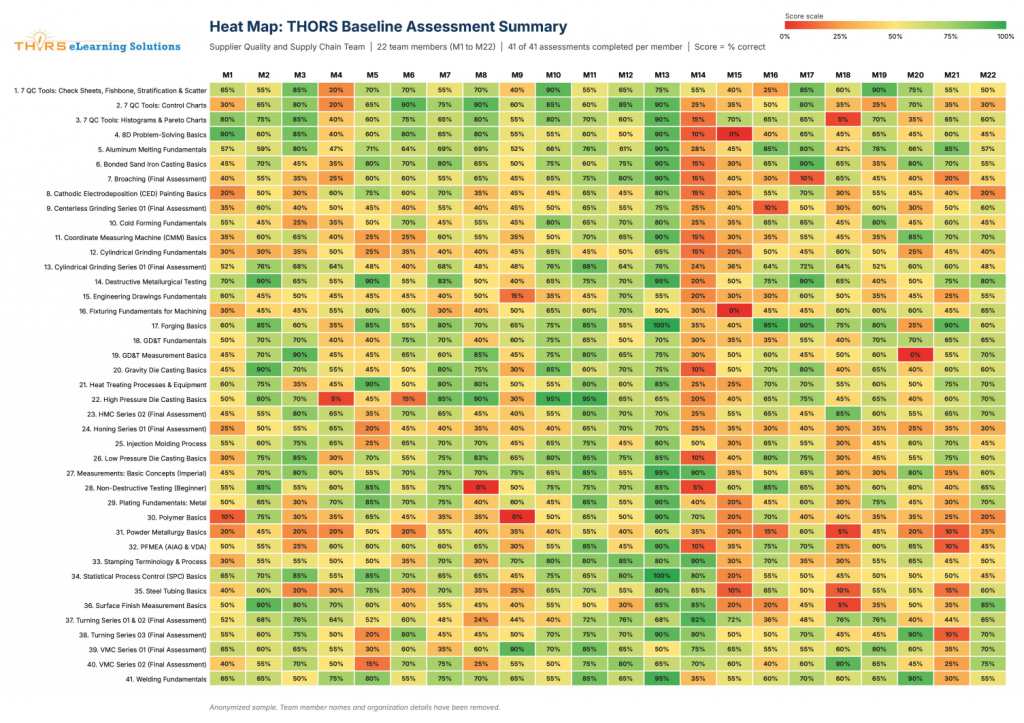
This assessment from an experienced supplier quality and supply chain team evaluated 22 employees across 41 technical topics related to their responsibilities in reviewing and approving supplier processes.
The results are presented in a color-coded heat map, providing a visual overview of technical knowledge across the team. Each column represents an employee, each row represents a technical topic, and each cell displays a score. Colors range from red for lower scores to green for higher scores, making patterns easy to identify.
Key findings:
The team’s overall average score across all 41 technical topics was 55%.
No topic achieved a team average above 70%, indicating room for improvement across all areas assessed.
Just 14% of assessment scores reached 80% or higher, suggesting a broader need for technical knowledge development.
Scores varied considerably from employee to employee, underscoring the importance of personalized training.
Baseline assessment results for a supplier quality and supply chain team of 22 members across 41 technical topics. Each column represents one team member and each row represents one topic. Cells are color-coded by score, from red (0%) to green (100%).
Pinpointing Individual Training Needs
The assessment revealed considerable differences in technical knowledge across the 22 team members, highlighting the need for individualized training. By scanning each employee’s column, areas requiring additional support become immediately apparent, providing a clear starting point for a personalized training plan.
Key findings:
16 of 22 team members scored below 50% on at least 10 topics.
The number of topics with scores below 50% varied widely, ranging from 2 to 30 per employee.
Across 40 of 41 topics, individual scores varied by at least 50 percentage points.
With a clearer understanding of individual needs, you can reduce unnecessary training and make better use of your resources. This targeted approach helps build a more capable workforce by developing the skills each employee needs to succeed.
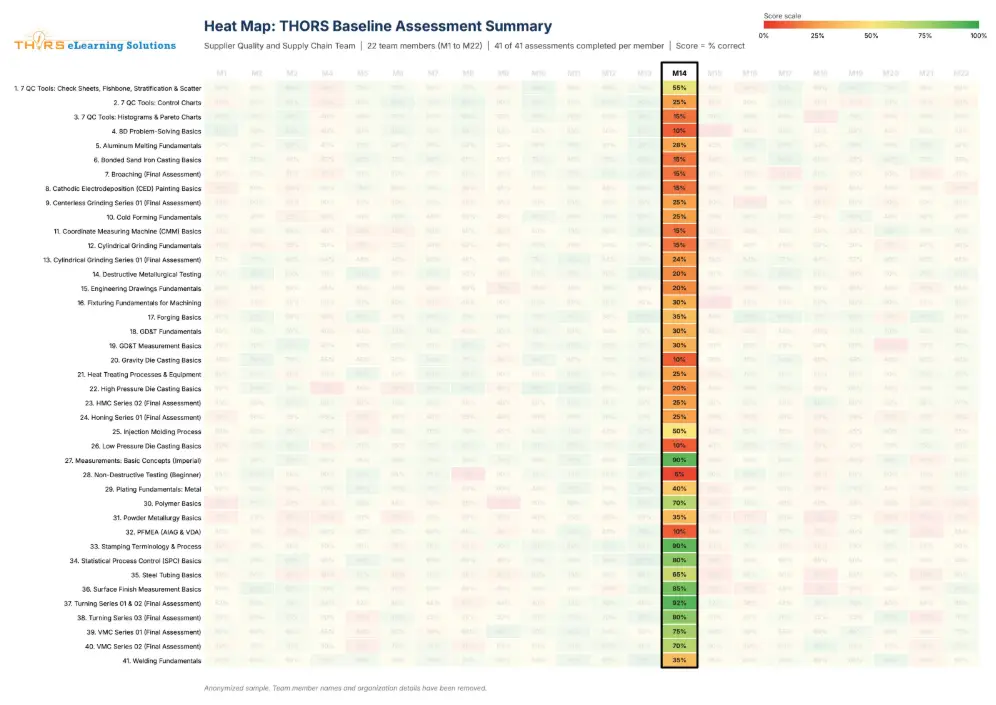
One team member’s results are highlighted, showing scores below 50% across 29 of the 41 topics assessed. This level of detail helps identify where additional training and support would be most beneficial.
Uncovering Company-Wide Blind Spots
Beyond individual training needs, the assessment revealed technical knowledge gaps affecting the broader team. Reviewing scores by topic made it easy to identify these organization-wide blind spots and determine where group training was needed.
Key findings:
In 8 technical topics, at least half of the team scored below 50%.
29 of the 41 topics had team average scores below 60%.
No technical topic achieved a team average above 70%.
Knowledge gaps shared across an entire team can go unnoticed, becoming a source of recurring problems. Recognizing these blind spots allows you to address them proactively through focused training rather than dealing with mistakes as they happen.
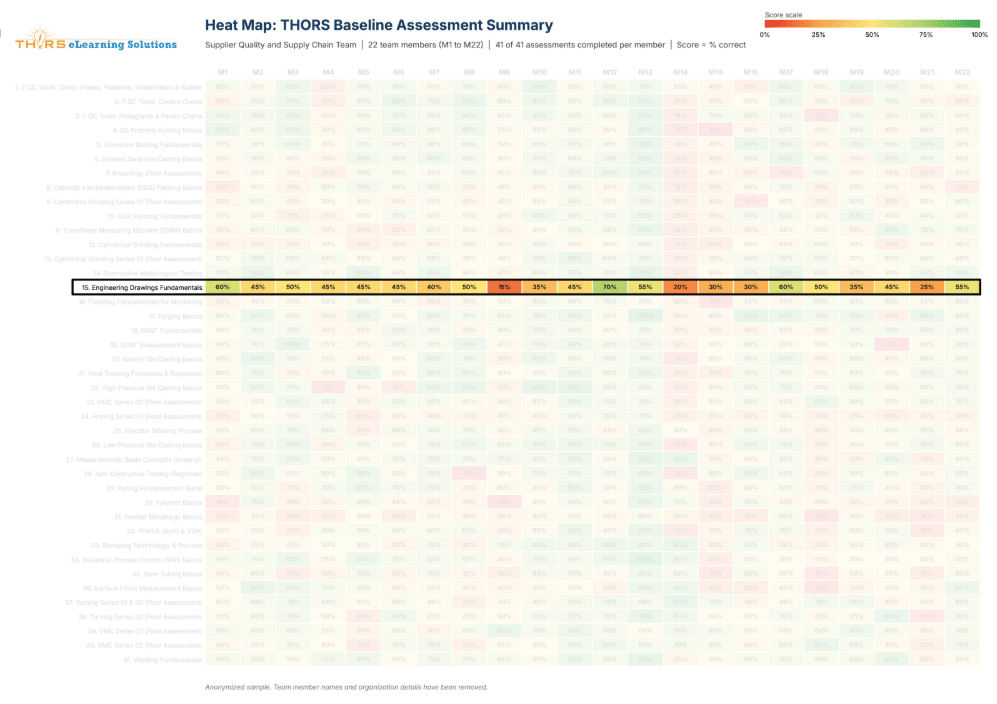
Engineering Drawings Fundamentals is highlighted as a shared knowledge gap, despite its importance to the team’s daily responsibilities. The results point to an opportunity for focused group training to strengthen a critical technical skill.
Leveraging Existing Expertise
The assessment also highlighted valuable technical expertise already present within the team. By identifying employees who achieved expert-level scores in specific topics, the organization could recognize team members whose knowledge could support training, problem-solving, and development across the workforce.
Key findings:
Expert-level knowledge was identified in 30 of the 41 technical topics assessed.
20 of 22 team members achieved an expert-level score in at least one topic.
24 technical topics had multiple team members demonstrating expert-level knowledge.
Understanding where your expertise exists helps you make more informed training decisions and get greater value from the talent already available. By building on your team’s existing strengths, you can develop a more capable workforce while reducing reliance on external resources.
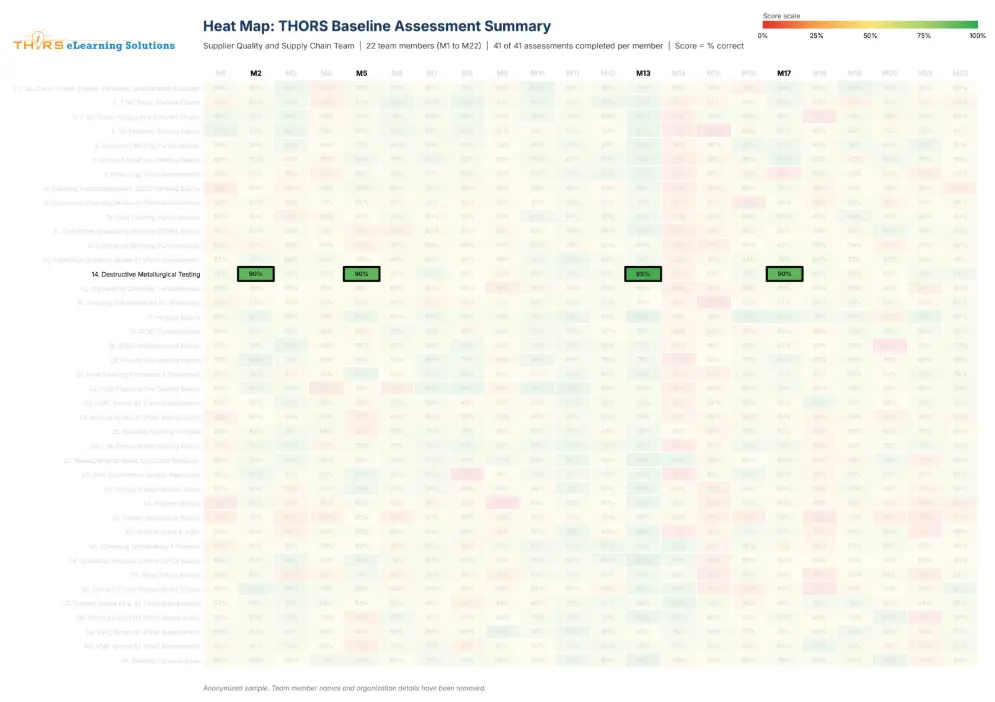
Four team members demonstrated expert-level knowledge in Destructive Metallurgical Testing. These results highlight employees whose expertise could support critical projects, problem-solving, and internal training efforts.
Conclusion
Every manufacturer has gaps like these. The difference is whether you can see them. A baseline assessment shows where each employee needs support, where shared knowledge gaps put quality at risk, and where existing expertise can be put to better use. With that visibility, you can direct your training investment where it will have the most impact and unlock the full potential of your workforce.
The energy storage sector is dominated by lithium-ion batteries (LIBs), which power more than 90% of the global grid market. The modern world revolves around…
What is the lithium-ion battery manufacturing process? Lithium-ion battery manufacturing is the method of producing lithium-ion batteries that employ lithium ions as their main source…
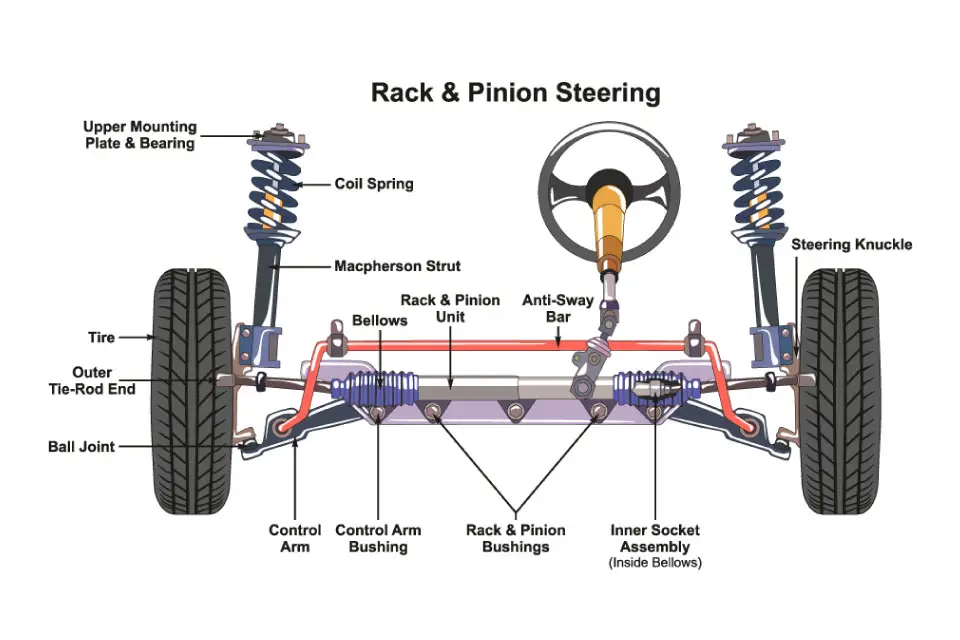
Have you ever driven a vehicle down the road and thought, how does this steering system work? Nowadays, we drive the most sophisticated, nearly flawless…