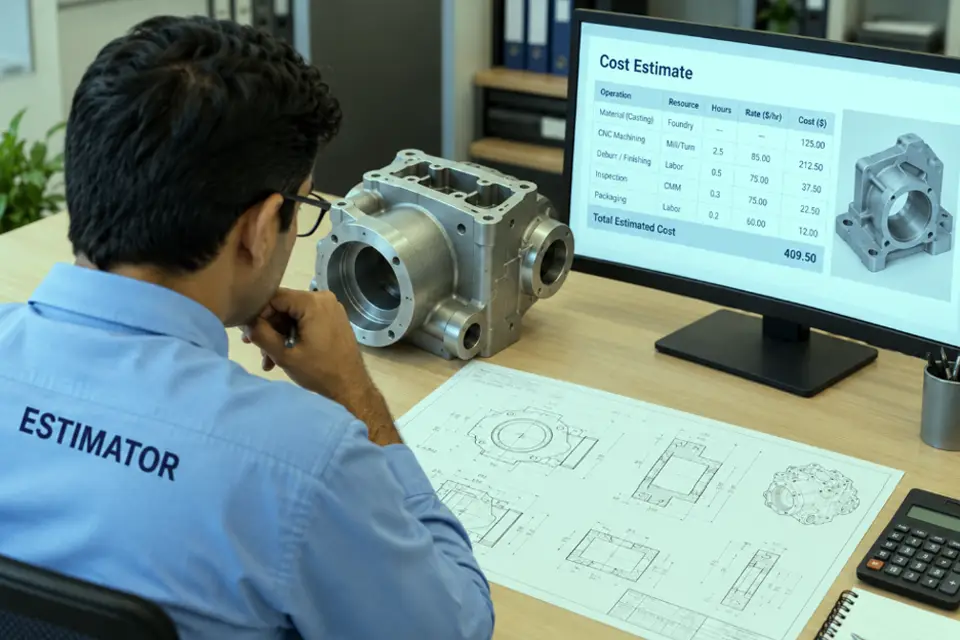
Sixty-seven percent of buyers expect a quote back in under 24 hours. A machined component cost estimate is the number a supplier commits to before starting to process the raw material. The estimate has to carry the bought-in casting or forging, the freight that brings it through the door, the machining itself, and everything the business needs to recover on top of all that. Get it right and the work pays for years. Get it wrong and you find out slowly.
Most of the pressure on that number is time. Paperless Parts, a company that builds quoting software for machine shops, cites the buyer survey behind that figure. An estimator is often building a figure in a single day that the business will then live with for as long as the part stays in production.
Here are four places that number goes wrong, and what each one costs.
Quoting High or Low
An estimate can miss in either direction, and the two failures feel nothing alike.
Quote too low and you win the work. That is the trap. The job arrives, the margin is not there, and every part you ship makes the hole deeper. The error is locked in for the length of the contract.
Quote too high and you lose, quietly. Nobody calls to say your number sat a few percent above the next supplier. The job goes elsewhere and you learn nothing from it.
David Senkfor, president of a manufacturing consultancy, writing in the gear industry publication Gear Solutions, describes a competitor’s salesman who asked customers what price they wanted and simply agreed to it, losing money on every job and trying to make it back on volume. His employer fired him. The estimate was not the only failure in that story, but it was the one that made the rest possible.
What it costs: the low miss costs margin on every part for the life of the program. The high miss costs the program itself, and hands you no feedback you could learn from.
The Order That Came in Smaller
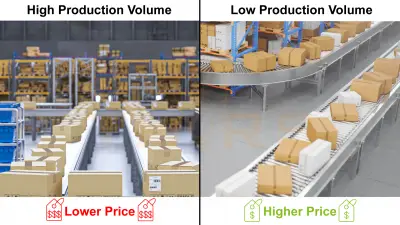
Every per-part price rests on an assumed quantity. When the real orders arrive below that assumption, the price you quoted stops being the price you needed.
Senkfor’s own arithmetic shows how fast that moves. The part cost 10 dollars a piece to make, with a 50-dollar setup charge to spread across the order. At 50 pieces that came to 11 dollars a piece. At 25 pieces the price was 16 dollars, and at 10 pieces it reached 25 dollars, as the setup spread across fewer parts and the shorter runs lost efficiency. Nothing about the part had changed. His standard cost system still carried the 50-piece figure while the shop was already paying 10 piece prices to its own suppliers.
What it costs: margin that erodes with no visible event to point at. Nothing broke. The orders just got smaller.
The Estimate Made in One Room
A machined component cost estimate draws on information held in at least five places. Manufacturers know what the engineering drawing actually demands. Purchasing knows what the casting supplier has been quoting lately and what freight has been doing. Manufacturing knows which machine the job will really land on, and how long setup takes when it is not going well. Accounting knows the recovery rates. Sales knows what the customer will tolerate.
When one person builds the number alone, they substitute an assumption for every one of those they cannot reach. The assumptions tend to be optimistic, because the person making them is working against a deadline.
What it costs: an estimate that is precise and wrong. Precision in a number built on guesses is worse than an honest range, because nobody thinks to question it.
The Estimate Nobody Checked
Most shops can tell you what they quoted. Far fewer can tell you what the job actually cost once it ran.
Without that comparison, an estimating error is invisible and permanent. The same optimistic setup time, the same stale material price, and the same hopeful scrap assumption go into the next quote, and the one after that. Paperless Parts lists failing to reference past quotes among the most common quoting mistakes, and points out that historical data is where pricing patterns become visible at all.
Checking an estimate against the actual result is the only thing that turns a method into a skill.
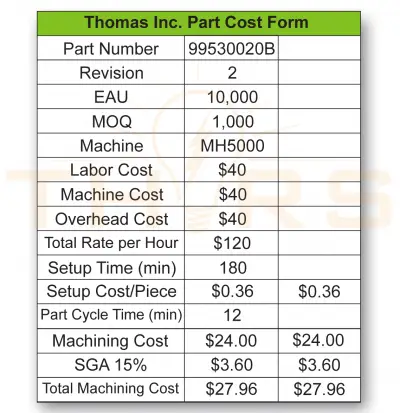
Building a Better Machined Component Cost Estimate
None of these four failures is about arithmetic. The arithmetic is the easy part. They are failures of assumption, of information, and of memory, and they survive comfortably in businesses that have never made their estimating method explicit.
A method that names its inputs, applies a consistent approach, and then gets checked against what actually happened will not make an estimator infallible. It will make the errors in a machined component cost estimate visible early enough to be worth something.
Costing a machined component well means knowing what belongs in the number before you commit to it, from the incoming request through to the quote you release. That is the method THORS’ new Costing Machined Components course walks through. Whether you estimate every day or only have to defend the numbers somebody else built, enroll today and work through the process from end to end.