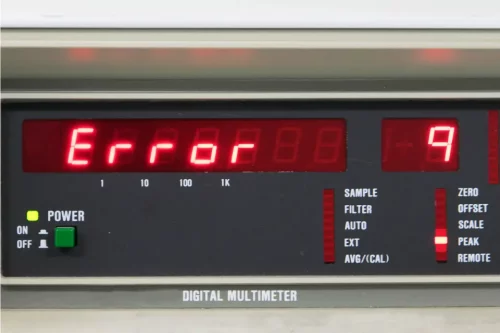
In electrical systems, accurate electrical measurement is critical for maintaining performance, ensuring safety, and reducing electrical measurement errors. However, electrical measurement errors can occur at any stage, and they often go unnoticed until they cause significant issues. From industrial automation to routine maintenance, accurate measurement is essential for enabling proper evaluation. Even experienced professionals can make errors that lead to incorrect readings and unintended consequences. Electrical measurement errors can affect system efficiency, increase maintenance requirements, and compromise operational safety.
Understanding Electrical Measurement Errors
Electrical measurement errors are the deviations between the actual value of an electrical quantity and the value obtained using an electrical measuring instrument. In practical applications, electrical measurement errors typically occur due to electrical measuring instruments, environmental conditions, or human factors, affecting the accuracy and reliability of measurements.
Understanding the causes of electrical measurement errors improves measurement accuracy and ensures reliable system performance.
Using an Inappropriate Measuring Instrument
Using an inappropriate measuring instrument is a common source of electrical measurement errors. Measuring instruments are designed with specific ranges, specific functions, sensitivities, and accuracy levels. When an instrument does not match the measurement requirement, the readings may not reflect the true value. For instance, using an instrument with low sensitivity may fail to detect small changes in the measured quantity. This leads to inaccurate interpretation of electrical parameters.
Skipping Calibration of Instruments
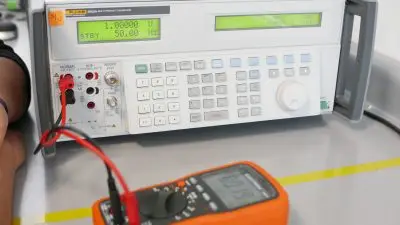
Skipping calibration of instruments leads to electrical measurement errors because measurement instruments do not maintain perfect accuracy over time. Due to aging components, wear, and environmental exposure, instruments typically exhibit drift, which causes consistent deviation in readings. If calibration is not performed, this deviation remains unnoticed and affects all subsequent measurements. This type of error is systematic and can significantly impact testing and monitoring processes. For instance, a voltage measuring instrument that has not been calibrated may consistently show a higher or lower value than the actual voltage, leading to inaccurate results over time.
Improper Observation of Readings
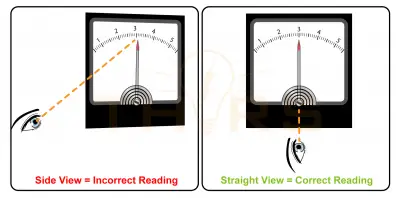
Improper observation of readings can lead to electrical measurement errors. Misreading the scale, recording incorrect values, or observing the instrument from an improper angle leads to inaccurate results. In analog instruments, parallax error is a common issue where the pointer appears to indicate different values depending on the viewing angle. These errors arise due to limitations in human observation and can affect measurement accuracy. For instance, when reading an analog meter from an angle instead of directly in front, the pointer may appear to indicate a different value.
Ignoring Environmental Factors
Ignoring environmental factors such as temperature, humidity, and electromagnetic fields can affect measurements. These factors can alter the internal characteristics of measuring instruments and introduce deviations in readings. For instance, temperature variations and external electromagnetic fields may distort signals. These influences are not always visible but can significantly impact measurement accuracy.
Relying on a Single Measurement
Relying on a single measurement can lead to inaccurate results because measurements can vary. Readings may fluctuate due to random noise, minor system instabilities, or transient disturbances. Consequently, a single reading may not accurately represent the true value of the measured quantity. For instance, measuring a fluctuating quantity only once may give a value that is higher or lower than the actual average.
Minimizing Electrical Measurement Errors
Electrical measurement errors can be minimized by following proper measurement practices such as:
• Ensuring proper instrument selection and regular calibration based on the required range, sensitivity, and accuracy
• Applying correct measurement techniques by observing readings carefully and using proper viewing positions
• Controlling environmental conditions to reduce external influences
• Improving measurement reliability by taking multiple readings and using the average value
Conclusion
Following these practices helps reduce electrical measurement errors and ensures accurate and consistent results for maintaining system performance, ensuring safety, and supporting effective decision-making. For those looking to develop a strong foundation in electrical measurement, the THORS Electrical Measurement Basics course offers a comprehensive introduction to electrical measurement concepts and commonly used measuring instruments.