Introduction
Why would a cast part that looks perfect on the outside leak under pressure or crack in service? The cause may be one of several common aluminum casting defects that affect the part’s internal soundness or structural integrity. Aluminum casting is the process of pouring molten aluminum into a shaped cavity, called a mold, and letting it harden into a part. A casting defect is any flaw that forms during this process and weakens the part, causes a leak, or makes the part fail inspection. Design decisions about part geometry, wall thickness, and the casting process can influence some of these defects.
A chapter on casting defects in the ASM Handbook, a reference series published by the materials society ASM International, groups them into seven categories.
The following five aluminum casting defects show how part geometry, solidification behavior, and casting conditions can influence part quality.
1. Gas Porosity
Gas porosity is a cluster of small, rounded holes, called pores, inside a casting. Molten aluminum absorbs hydrogen, a gas that comes mainly from moisture in humid air, damp tools, and scrap metal added to the furnace. Gas porosity can result from hydrogen coming out of solution as aluminum solidifies or from gas trapped during mold filling. Batesville Products, an aluminum foundry in Indiana, notes that fast pouring can also trap air. Foundries remove hydrogen by degassing, which means bubbling a dry gas such as argon through the molten metal before casting.
Design Factors:
Gas porosity mainly comes from dissolved hydrogen and air trapped during casting, rather than from part geometry alone. Still, designers should consider how the selected casting process fills the part, particularly where complex passages or thin sections make smooth metal flow difficult. For example, a hydraulic valve body needs sound, leak-tight walls to hold pressurized oil. Designers should therefore review its geometry and casting method together to reduce the risk of trapped gas and leakage.
2. Shrinkage Porosity
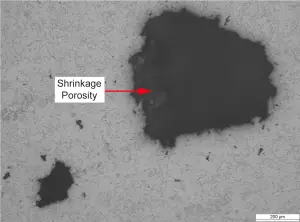
Aluminum shrinks as it changes from liquid to solid. In most areas, liquid metal keeps flowing in to fill the space this shrinkage leaves behind. Problems start when a thick section is surrounded by thinner ones. The thin areas harden first and cut off the flow of liquid metal. The thick area, often called a hot spot, hardens last, and with no liquid metal left to fill it, a void forms. This void is rougher in shape than a gas pore. Shrinkage is one of the aluminum casting defects most closely tied to part shape, so sudden changes in wall thickness get close attention during design.
Design Factors:
Sudden changes in wall thickness and isolated heavy sections can create hot spots that are difficult to feed as the metal solidifies. Designers can reduce this risk by keeping sections as uniform as practical and reviewing how thick features connect to surrounding walls. For example, the bolt bosses of an aluminum cylinder head need enough material to support the bolts. Their thickness and location must also let liquid metal feed them during solidification.
3. Hot Tearing
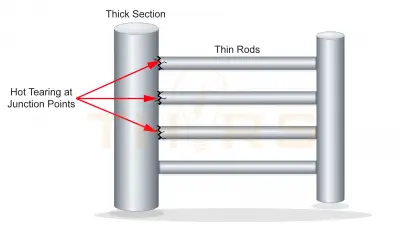
Hot tearing, also called hot cracking, is one of the aluminum casting defects in which the metal cracks during the final stage of solidification. At this stage, the metal is still weak because thin films of liquid remain inside it. If the mold or the shape of the part stops the metal from shrinking freely, it tears apart along these weak areas. Hot tears usually appear at sharp corners and where thick and thin sections meet. Their surfaces are often dark because they oxidize, or react with air, while the metal is still hot.
Design Factors:
Sharp inside corners, abrupt section changes, and shapes that restrict contraction during solidification can increase the risk of hot tearing. Smooth transitions and suitable corner radii can help the metal shrink more freely, although mold restraint and process conditions also matter. For example, a cast aerospace bracket with a sharp junction may be more prone to a hot tear, which can later grow under repeated vibration.
4. Cold Shuts and Misruns
Cold shuts and misruns happen when molten aluminum cools too much before it fills the mold. A cold shut forms when the metal splits into separate flows inside the mold, for example around a hole, and these flows meet again but are too cool to join. This leaves a weak seam that looks like a crack. A misrun happens when the metal hardens before it reaches the end of the mold, leaving the casting incomplete. Common causes include a low pouring temperature, slow filling, and long flow paths through very thin walls.
Design Factors:
Very thin walls, long flow paths, and abrupt changes in section thickness can make it difficult for molten aluminum to fill the mold before cooling. Designers should check wall thickness and part geometry against the capabilities of the chosen casting process. For example, aluminum heat sinks have thin fins that carry heat away from electronic components. If a fin is too thin or difficult to fill, a misrun may leave it incomplete and reduce its effectiveness.
5. Inclusions
Inclusions are pieces of unwanted material trapped inside a casting. In aluminum, the most common type is oxide film. Molten aluminum reacts with air as soon as it is exposed, forming a thin layer of aluminum oxide on its surface. When the metal is stirred or poured roughly, this oxide layer folds into the molten metal and becomes trapped inside the casting as a weak, crack-like film. Other inclusions come from sand or pieces of the furnace lining. Inclusions weaken the part, act as starting points for cracks, and can damage cutting tools during final machining.
Design Factors:
Inclusions mainly depend on melt cleanliness, turbulence, and mold materials, so changing the part shape alone will not prevent them. However, part complexity and the selected casting process can affect how the mold fills and where turbulent flow may occur. Designers should also identify critical machined and sealing surfaces early. For example, an inclusion exposed on the machined sealing face of an outboard motor housing can create a leak path for water or oil.
Why Aluminum Casting Defects Start at the Design Stage
Design decisions made before casting can influence the formation of certain aluminum casting defects. Thick sections can increase shrinkage risk, sharp corners can contribute to hot tearing, and long, thin flow paths can lead to cold shuts or misruns. Gas porosity and inclusions, on the other hand, depend more heavily on melt handling and process control. This is why Design for Manufacturability (DFM) matters. Designers and foundries need to review geometry, metal flow, solidification behavior, and process limitations together before they finalize tooling.
Understanding aluminum casting defects is only the start. Want to learn what shapes a cast part, from design requirements and cost to material selection and common aluminum casting alloys? THORS’ new Aluminum Casting Design Essentials course covers it all. Whether you are new to cast part design or looking to strengthen your foundation, enroll today and design aluminum castings that perform as intended.