What Is EMC in Automotive Wiring Harness Design?
Electromagnetic Compatibility (EMC) in automotive wiring harness design is the ability of a wiring harness and its connected electrical equipment to operate correctly within the vehicle’s electromagnetic environment – without generating excessive Electromagnetic Interference (EMI) and without being adversely affected by EMI from other electrical or electronic sources.
The wiring harness acts as the central nervous system of a modern vehicle, which is packed with dozens of Electronic Control Units (ECUs), sensors, high-speed data networks, and electric powertrains. In this complex environment, EMC ensures that electrical systems function reliably without causing or suffering from interference. Without proper EMC control, even a perfectly functional electrical circuit can fail under real-world vehicle conditions.
EMC compliance standards are defined by the Special Committee on Radio Interference (CISPR), International Organization for Standardization (ISO), and Society of Automotive Engineers (SAE).
5 EMC Design Strategies in Automotive Wiring Harnesses
In automotive harness design, EMC is addressed through structured design strategies. These include maintaining adequate spacing between power and signal lines, implementing twisted pair wiring for communication lines, applying shielding, ensuring controlled grounding architecture, and managing current return paths.
Each of these strategies helps reduce electromagnetic interference and maintain signal integrity within the vehicle environment.
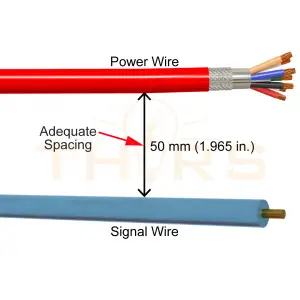
1. Maintaining Adequate Spacing Between Power and Signal Lines
Adequate spacing between power and signal lines is essential to maintain EMC. Signal wires and cables must be kept at a safe distance from power wires and cables carrying high current to prevent EMI. A minimum distance of 50 mm (1.9685 in.) is typically required to maintain data integrity. Insufficient spacing can lead to electrical noise, crosstalk, and overall system malfunction. Proper separation reduces coupling between circuits and helps ensure stable system performance.
2. Implementing Twisted Pair Wiring for Communication Lines
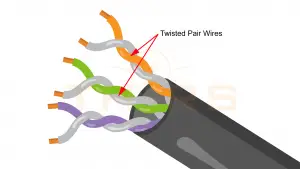
Implementing twisted pair wiring for communication lines improves EMC performance by reducing EMI through electromagnetic field cancellation. Because automotive communication networks use differential signaling, the receiver processes only the voltage difference between the two conductors and rejects common-mode noise.
When two wires are twisted together, any external electromagnetic noise induces nearly equal voltages in both conductors. Twisting also minimizes the loop area between the wires, which reduces both radiated emissions and susceptibility to external interference. As a result, signal integrity is improved and overall electromagnetic compatibility of the wiring harness is enhanced.
3. Applying Shielding to Control EMI
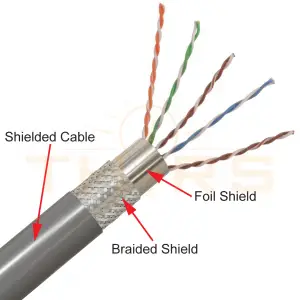
Applying shielding through components such as braided shields, foil shields, or shielded cables helps improve EMC by controlling EMI. A braided shield, made of woven metal strands, provides strong mechanical protection along with effective noise suppression. A foil shield, typically made of aluminum, offers high coverage and is particularly effective against high-frequency interference. A shielded cable combines protective layers around the conductors to block external noise from entering and to prevent internal signals from radiating outward.
When the shield is properly grounded, unwanted electromagnetic energy is safely diverted to ground, improving signal stability and overall electromagnetic compatibility in the wiring harness.
4. Ensuring a Controlled Grounding Architecture
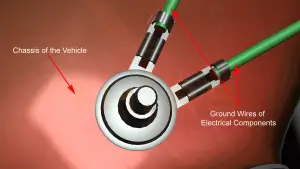
Ensuring a controlled grounding architecture supports EMC by providing a clear and stable path for return currents and unwanted electrical noise. Strategies such as direct grounding, star grounding, and the use of ground straps are commonly applied to manage current flow effectively.
Direct grounding connects equipment to a defined chassis ground point. Star grounding brings multiple grounds to a single common point to prevent ground loops. Ground straps provide low-resistance bonding between components and the vehicle body. These approaches prevent circulating currents and voltage differences that can create interference, allowing noise to dissipate safely and improving overall electromagnetic compatibility in the wiring harness.
5. Managing Current Return Paths
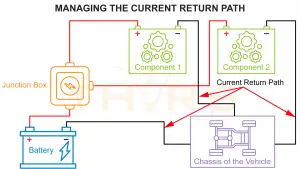
Managing current return paths is essential for EMC because it ensures that electrical current flows back to its source, typically the battery, through a controlled and predictable path. When return currents are routed close to their corresponding supply conductors, the loop area between the outgoing and return paths is minimized, reducing electromagnetic radiation and lowering interference.
If return currents take unintended paths through the chassis or other circuits instead of returning cleanly to the battery ground, they can spread electrical noise and disturb sensitive signals. By carefully managing return paths, unwanted emissions are reduced and signal integrity within the wiring harness is maintained.
Conclusion
In conclusion, EMC in automotive wiring harness design is not just a regulatory requirement but a fundamental design responsibility that directly affects vehicle reliability, safety, and performance. A well-designed harness ensures that every electrical equipment functions consistently in real-world operating conditions.
As vehicles continue to integrate more electronic systems and high-speed communication networks, strong EMC practices will remain essential to achieving stable, noise-free, and dependable vehicle operation.
Do you want to learn more about the electrical and mechanical principles of wiring harness integration? Visit our website and explore our Wiring Harness Integration Course.