Aluminum is widely valued for being lightweight, corrosion-resistant, and easy to fabricate. However, in its raw or untreated form, aluminum often falls short of the mechanical and dimensional stability required for demanding industrial applications.
This is where heat treatment of industrial aluminum products becomes essential. It is not simply a secondary manufacturing step; it is a critical process that determines how aluminum performs under stress, temperature variation, and long-term service conditions.
To understand why heat treatment matters, we must look beyond surface appearance and examine how aluminum behaves internally.
Heat Treatment of Aluminum
Industrial aluminum heat treatment is a controlled process in which aluminum is heated and cooled under specific conditions to alter its internal structure and improve its mechanical properties. Although aluminum alloys may be cast, rolled, or extruded into shape, these processes alone do not provide the strength, stability, or consistency required for most structural and high-performance applications.
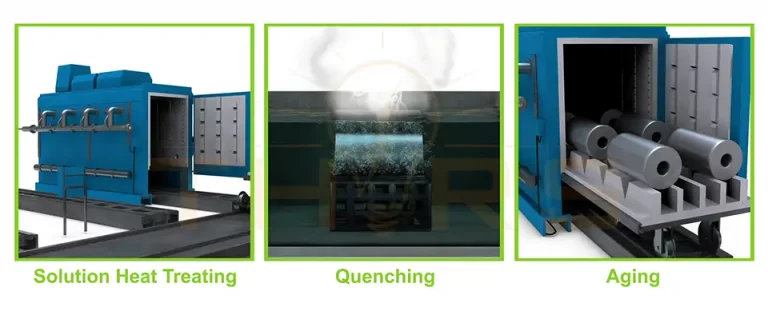
The heat treatment of aluminum typically involves three main stages, each serving a distinct purpose.
- Solution Heat Treating
Solution heat treating involves heating the aluminum alloy to a temperature where alloying elements dissolve into the aluminum matrix. This creates a uniform microstructure and prepares the material for strengthening. - Quenching
Quenching follows solution heat treatment and involves rapidly cooling the material, commonly using water, polymer solutions, or air. Rapid cooling “locks” the alloying elements in place and prevents premature precipitation that would reduce strength. - Aging (Natural or Artificial)
Aging is the final stage, during which aluminum develops its full mechanical properties. Aging may occur naturally at room temperature or artificially at elevated temperatures. During this phase, fine precipitates form within the metal, significantly increasing strength and hardness.
How Heat Treatment Improves Aluminum Properties
Untreated or poorly treated aluminum may appear acceptable externally, but its internal structure often reveals lower tensile and yield strength, inconsistent hardness, dimensional instability, and residual stresses from forming operations. Heat treatment addresses these limitations by enabling predictable and repeatable performance.
Increased Strength
One of the most common issues with untreated aluminum is softness. Without heat treatment, aluminum frequently lacks the strength required to withstand mechanical loads, making it unsuitable for load-bearing or high-performance applications.
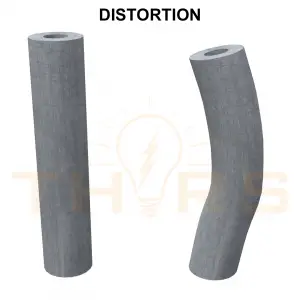
Reduced Warping and Distortion
Another frequent issue is warping and distortion. Aluminum components that have not been properly stress-relieved tend to deform during machining, welding, or in service. This results in dimensional inaccuracies, poor fitment, and costly rework.
Prevention of Hidden Failures
More critically, some failures remain hidden. Internal stresses, uneven grain structures, or incomplete strengthening mechanisms may not be immediately visible. These defects often emerge later as cracking, fatigue failure, or premature wear, when the cost of failure is significantly higher.
Why Heat Treatment Is Critical Across Industries
Automotive
In the automotive industry, heat-treated aluminum enables vehicle weight reduction without compromising safety. Stronger aluminum components improve crash performance while contributing to improved fuel efficiency and electric vehicle range.
Aerospace
In aerospace applications, heat treatment is indispensable. Aircraft components must withstand extreme loads, temperature variations, and long fatigue cycles. Even minor deviations in material properties can pose serious safety risks.
Construction
In construction, heat-treated aluminum ensures that structural components maintain strength and dimensional accuracy over long service lives, particularly in load-bearing and architectural applications exposed to environmental stress.
Electronics and Precision Equipment
In electronics and precision equipment, heat treatment improves dimensional stability, allowing components to maintain tight tolerances during machining and operation.
The Cost of Getting Heat Treatment Wrong: Why Manufacturers Cannot Afford to Overlook It
When heat treatment is skipped, rushed, or poorly controlled, the consequences extend beyond material performance. The immediate impact is often seen on the shop floor, where manufacturers experience higher scrap rates, increased rework, and production delays caused by failed inspections or non-conforming parts.
In regulated or safety-critical industries, these failures can escalate into compliance violations, audits, or recalls, increasing both operational and legal risk. Beyond these direct costs lies a more lasting consequence: damage to brand credibility. Product failures in the field erode customer confidence, even when the root cause lies deep within the manufacturing process. Over time, recurring quality issues can undermine a manufacturer’s reputation, making recovery far more expensive than investing in proper heat treatment from the outset.
Making Heat Treatment a Quality Standard, Not a Checkpoint
One of the most common mistakes manufacturers make is treating heat treatment as a final checkpoint rather than a core quality standard. Effective heat treatment requires strict process control, including accurate temperature calibration, verified soak times, controlled quenching, and consistent aging conditions.
Equally important are testing and validation. Mechanical testing, hardness, and measurement inspections confirm that the process has delivered the intended results. To ensure consistency and compliance, many manufacturers align their heat treatment processes with established industry standards such as ASTM (American Society for Testing and Materials) and AMS (Aerospace Material Specifications). These standards define acceptable heat treatment practices, material properties, and testing requirements, helping manufacturers achieve repeatable quality and traceability across production batches.
When heat treatment is embedded into the quality system rather than treated as an afterthought, product consistency, performance, and reliability improve significantly.
Heat Treatment as a Safeguard for Performance and Reputation
Heat treatment is not just about making aluminum stronger. It is about making it reliable, predictable, and fit for purpose. Proper heat treatment safeguards in-service performance, protects manufacturers from costly failures, and upholds brand reputation in competitive markets.
As aluminum products are expected to deliver more strength with less weight and tighter tolerances, heat treatment is no longer optional. It is the silent process that determines whether an aluminum product merely exists or truly performs.
If you are interested in learning more about heat treating aluminum products, the THORS Heat Treating Aluminum Products course would be a good place to start.